Israeli army sets up military bases in Syria

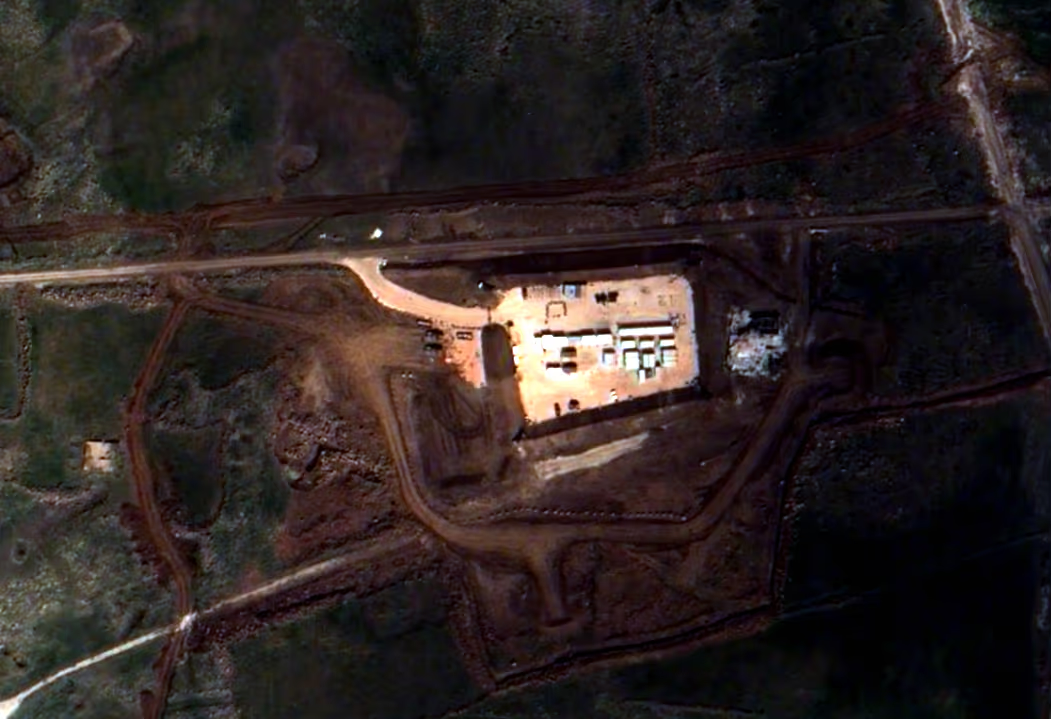
Images taken at various times show that a large military base has been under construction near the town of El Hmidaiah since January. This was reported by the Süddeutsche Zeitung.
In the first days after the Assad regime was overthrown, Israel began flying attacks against Syria and destroyed its military equipment.
What happened before: At the end of November 2024, the HTS, an Islamist alliance of various militias, launched an offensive in Aleppo. Just a few days later, on December 7, the rebels took control of Homs. Then, on December 8, Damascus was captured with almost no resistance, as government troops had already vacated their posts. On the same day, Bashar al-Assad fled Damascus by plane to Moscow.
Shortly afterwards, images of people storming and looting the presidential palace and Assad's residence were broadcast around the world. The reception hall of the presidential palace was set on fire. In Germany, too, thousands took to the streets to celebrate the fall of the regime.
On December 9, just one day after the fall of the regime is complete, various media outlets report Israeli attacks on Syria. The Syrian Observatory for Human Rights is the first to report that Israel has attacked over 100 targets in the country within a few hours. The apparent aim is to destroy military installations. The German Press Agency reports that the air strikes hit research centers, weapons depots, naval ships, airports, and air fleets.
Almost simultaneously, tanks roll into Syrian territory. Specifically, into the demilitarized zone, a buffer zone near the Golan Heights annexed by Israel.
The buffer zone was created in the aftermath of the Six-Day War and the subsequent Yom Kippur War. During the Six-Day War, Israel occupied the Golan Heights. Israel then settled the area before Syria was able to recapture parts of the Golan during the Yom Kippur War. In October 1973, the UN Security Council demanded that Israel withdraw. The following year, the buffer zone was established by the United Nations. It is under the supervision of UN blue helmets, the peacekeeping forces of the United Nations.
With the attacks and the deployment of Israeli troops, Israel apparently took advantage of the confusing situation in Syria at the moment of the fall. There are several reasons for this move: On the one hand, Israel could prevent a potential threat from Syria. On the other hand, Israel would also cut off Iran's supply lines to the Hezbollah militia in Lebanon. At least that is how the ARD (a German public-service broadcaster) interpreted it shortly after the events in December.
According to Prime Minister Benjamin Netanyahu, the measure is only temporary.
Our satellite images and research by the Süddeutsche Zeitung suggest a different picture. On April 25, more than four months after the troop deployment, the SZ wrote:
“Last week, Israeli forces bombed the airports of the former Syrian army and occupied further swathes of land. Checkpoints are being set up and entire villages are under curfew. Farmers are not allowed to go to their fields and entire families are being driven out. Meanwhile, as its soldiers continue to advance into southern Syria, Israel is even organizing hiking tours in the newly occupied territories.”
The question arises as to how Israel will proceed in Syria. Israel recently attacked targets in Damascus. According to the army, fighter jets struck the area around the Israeli president's palace. According to Prime Minister Netanyahu and Defense Minister Israel Katz, this was a message to the Syrian regime threatening the Druze, a religious minority that lives in Syria, among other places. The religious community emerged from Shiite Islam.
For its research, the SZ evaluated and geolocated satellite images as well as other image material, such as drone footage and videos published by the IDF itself.


